
Diesel Turbocharger Failure: Warning Signs, Causes and What to Do
Jan 30th 2026
Table of Contents
- Introduction
- How Diesel Turbochargers Work
- Warning Signs of Turbo Failure
- Common Causes of Turbocharger Failure
- Diagnostic Steps for Turbo Problems
- When to Repair vs Replace Your Turbo
- Turbocharger Replacement Costs
- Preventing Future Turbo Failure
- Related Components to Inspect
- Platform Specific Turbo Issues
- Frequently Asked Questions
- Bostech Turbo Solutions
Introduction
Your diesel turbocharger operates under some of the most extreme conditions of any engine component. Spinning at speeds exceeding 80,000 RPM while enduring exhaust temperatures approaching 1,500°F, even the most robust turbocharger eventually shows signs of wear. Understanding the warning signs of diesel turbo failure can mean the difference between a straightforward repair and catastrophic engine damage costing thousands of dollars.
This comprehensive guide covers everything diesel truck owners and fleet operators need to know about turbocharger problems, from early warning symptoms to diagnostic procedures, repair decisions, and preventive maintenance strategies that extend turbo life.
How Diesel Turbochargers Work
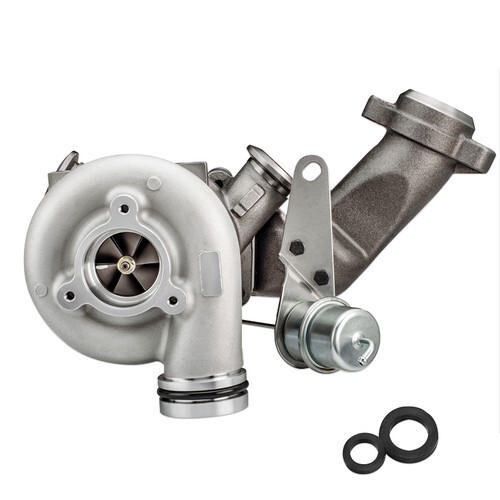
A turbocharger transforms exhaust energy that would otherwise be wasted into usable power. When exhaust gases exit the engine, they spin a turbine wheel connected to a shaft. On the opposite end of that shaft sits a compressor wheel that draws in fresh air, compresses it, and forces it into the engine. This compressed air contains more oxygen molecules, allowing the engine to burn more fuel and produce significantly more power than a naturally aspirated design.
Diesel turbochargers operate under far more demanding conditions than their gasoline counterparts. Stock diesel trucks typically run boost pressures around 30 PSI, while modified applications may see 40 to 100 PSI or more. The turbine housing regularly experiences temperatures that would melt many metals, while the center section relies on a thin film of engine oil for both lubrication and cooling.
Modern diesel trucks commonly use Variable Geometry Turbochargers (VGT), also called Variable Nozzle Turbines (VNT). These sophisticated units feature adjustable vanes inside the turbine housing that change position based on engine demand. At low RPM, the vanes close to accelerate exhaust velocity and provide quick boost response. At higher RPM, they open to prevent overboosting while maintaining optimal efficiency. This technology delivers the performance of a large turbo at high speeds with the responsive spool of a smaller unit at low speeds.
Understanding how your turbocharger functions helps you recognize when something goes wrong. Early diagnosis often prevents minor issues from becoming major failures.
Warning Signs of Turbo Failure
Turbocharger problems rarely appear without warning. Recognizing these symptoms early gives you the best chance of addressing issues before they cause secondary damage.
Excessive Exhaust Smoke
Smoke color tells a story about what is happening inside your turbocharger:
- Blue or gray smoke typically indicates oil burning inside the turbo system, often from failed seals allowing oil into the exhaust or intake
- Black smoke during acceleration suggests an improper air to fuel ratio, often caused by insufficient boost or restricted airflow
- White smoke may indicate coolant entering the combustion chamber through a cracked turbo housing or failed gasket
The timing of smoke production matters as well. Smoke that appears primarily during acceleration often points to turbo seal failure, while smoke at idle may indicate different issues entirely.
Loss of Power and Poor Acceleration
When a turbocharger fails to produce adequate boost, power loss becomes immediately noticeable. Your truck may feel sluggish during acceleration, struggle to maintain highway speeds, or labor when climbing grades. Towing capacity suffers significantly, and you may notice the engine working harder to accomplish tasks that previously seemed effortless.
This power loss occurs because the turbo cannot compress sufficient air for optimal combustion. Without adequate boost pressure, fuel economy drops while exhaust gas temperatures rise.
Unusual Noises
A healthy turbocharger produces a characteristic whistle during operation. When bearings wear or internal components fail, that sound changes dramatically:
- High pitched whining or screaming often indicates bearing failure and internal contact between rotating components and the housing
- Grinding or scraping noises suggest the compressor or turbine wheel has contacted its housing
- Rattling sounds may point to loose components or foreign object damage
- Excessive turbo whistle or flutter can indicate boost leaks or wastegate problems
Any new or unusual noise from the turbocharger area warrants immediate investigation.
Check Engine Light and Diagnostic Codes
Modern diesel trucks monitor turbocharger performance continuously. Common trouble codes related to turbo problems include:
- P0299: Turbo underboost condition, indicating the turbo is not producing expected boost pressure
- P0046: Turbo boost control circuit range or performance issue
- P2263: Turbo boost system performance problem
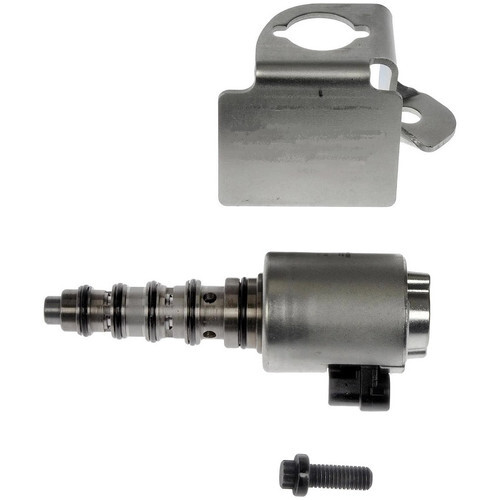
- P003A: Turbocharger boost control position exceeding learning limit
- P226C: Turbo boost control slow response
These codes often appear before physical symptoms become obvious, making regular code scanning a valuable diagnostic practice.
Increased Oil Consumption
Failed turbocharger seals allow oil to escape into either the intake or exhaust systems. If your truck suddenly requires more frequent oil additions between changes, turbo seal failure may be the culprit. Check for oil residue around turbo connections and inspect the intake tract for excessive oily buildup.
Extended Turbo Lag
Variable geometry turbos should provide responsive boost delivery across the RPM range. When vanes stick due to carbon buildup or actuator failure, boost response suffers noticeably. If your truck takes significantly longer to build boost than it did previously, VGT system problems likely exist.
Common Causes of Turbocharger Failure
Industry data reveals that more than 90 percent of turbocharger failures trace back to just a few root causes. Less than one percent result from manufacturing defects. Understanding these causes helps you prevent failures before they occur.
Oil Starvation
Turbocharger bearings require constant oil flow for lubrication and cooling. When oil supply becomes restricted or interrupted, bearing surfaces experience metal to metal contact, generating extreme heat and rapid wear. Oil starvation occurs from:
- Clogged or kinked oil feed lines
- Low engine oil level
- Delayed oil pressure at startup
- Oil cooler blockage
- Insufficient oil priming after turbo replacement
Even brief periods of oil starvation cause cumulative damage that shortens turbo life.
Oil Contamination
The precision machining inside a turbocharger rivals that of fuel injection components. Bearing clearances measured in ten thousandths of an inch cannot tolerate contamination. Dirty oil carries abrasive particles that score bearing surfaces and accelerate wear. Contamination sources include:
- Extended oil change intervals
- Low quality or incorrect oil specification
- Bypass of oil filtration
- Coolant intrusion into the oil system
- Fuel dilution from injector problems
Using the correct oil grade and maintaining strict change intervals protects your investment in turbocharger longevity.
Foreign Object Damage
Debris entering either the intake or exhaust side of the turbo causes immediate damage. On the compressor side, even small particles impact spinning blades at tremendous velocity. Common ingestion sources include:
- Failed air filter elements
- Debris left in intake piping during repairs
- Deteriorating intake boots and couplers
- Carbon chunks from failed EGR coolers
Exhaust side damage typically results from failed exhaust valves, broken piston rings, or debris from upstream component failures.
Carbon Buildup and Stuck Vanes
Variable geometry turbochargers rely on movable vanes for boost control. Soot and carbon deposits accumulate on these vanes and the unison ring that controls them. Over time, buildup restricts vane movement, causing:
- Stuck vanes that cannot adjust to engine demand
- Erratic boost behavior
- Overboost or underboost conditions
- Limp mode activation
This problem affects virtually all VGT equipped diesel trucks and worsens with excessive idle time or incomplete regeneration cycles.
Hot Shutdown Damage
Shutting down immediately after hard driving traps extreme heat in the turbo center section. Without oil circulation for cooling, temperatures can cause oil to coke and form deposits on bearing surfaces. This practice accelerates wear and promotes carbon formation that leads to premature failure.
Seal Degradation
The seals between the turbo center section and both the compressor and turbine housings eventually wear. Age, heat cycling, and pressure differentials all contribute to seal deterioration. Failed seals allow oil migration that produces smoke and reduces lubrication effectiveness.
Diagnostic Steps for Turbo Problems
Proper diagnosis prevents unnecessary parts replacement and identifies root causes that could damage a new turbocharger.
Visual Inspection
Start with a thorough visual examination of the turbocharger and surrounding components. Look for:
- Oil leaks around turbo flanges and connections
- Damaged or deteriorated intake boots and couplers
- Loose clamps that could allow boost leaks
- Carbon deposits indicating exhaust leaks
- Damaged wiring to VGT actuators or sensors
Remove the intake tube at the compressor inlet and inspect the compressor wheel. Look for blade damage, erosion, oil residue, or witness marks showing housing contact.
Shaft Play Testing
Grasp the compressor wheel nose and check for excessive play. Some radial movement exists by design due to oil film bearing clearances. However, you should not feel:
- Axial play allowing the shaft to move in and out
- Contact between the wheel and housing when pushing sideways
- Grinding or roughness when spinning the wheel
Any of these conditions indicates internal damage requiring turbo service or replacement.
Boost Leak Testing
Boost leaks mimic turbo failure symptoms while the turbocharger itself remains healthy. Pressurize the intake system to identify leaks at:
- Intercooler connections and piping
- Charge air cooler pipe boots
- Intake manifold gaskets
- EGR system connections
Even small leaks significantly impact performance and fuel economy.
Code Reading and Live Data
Connect a quality scan tool capable of reading manufacturer specific codes and live data. Monitor:
- Actual versus desired boost pressure
- VGT vane position and commanded position
- Turbo inlet pressure
- Exhaust back pressure
- Mass airflow readings
Comparing these values to specifications helps pinpoint problems within the turbo system.
When to Repair vs Replace Your Turbo
The decision between rebuilding and replacing a turbocharger depends on several factors including damage extent, parts availability, cost comparison, and time constraints.
Consider Rebuilding When
Turbocharger repair makes sense when:
- Damage is limited to bearings, seals, and thrust components
- Compressor and turbine wheels show no significant damage
- Housings have no cracks or severe erosion
- Quality rebuild parts are readily available
- The turbo has special features or modifications worth preserving
Rebuilding costs typically range from $400 to $1,500 depending on the turbo model and required components.
Choose Replacement When
Complete replacement becomes the better option when:
- Wheel damage exists from foreign object ingestion
- Housing cracks are present
- Shaft damage extends beyond bearing surfaces
- Time constraints demand faster turnaround
- Rebuild costs approach replacement prices
- Upgraded performance justifies new equipment
Remanufactured vs New Turbochargers
Quality remanufactured turbochargers offer excellent value for stock replacement applications. Reputable remanufacturers completely disassemble units, replace all wear components, balance rotating assemblies, and test completed units. Expect to pay $1,000 to $2,500 for a remanufactured VGT unit versus $2,500 to $4,500 or more for new OEM replacement.
When evaluating remanufactured options, consider warranty coverage, the rebuilder's reputation, and whether they test units on calibrated equipment. Avoid ultra cheap options that may use substandard components or skip critical testing procedures.
Turbocharger Replacement Costs
Total replacement costs include both parts and labor, with significant variation based on vehicle application and shop rates.
Parts Costs
Turbocharger prices vary dramatically based on type and source:
- Remanufactured stock replacement VGT: $1,000 to $2,500
- New OEM turbocharger: $2,000 to $6,000
- Performance aftermarket upgrades: $1,500 to $4,000 and up
Variable geometry units cost more than fixed geometry designs due to their complexity. Compound turbo systems double parts costs.
Labor Costs
Professional installation typically runs $500 to $800 for most pickup applications, though some configurations require significantly more time. Factors affecting labor include:
- Turbo accessibility on the specific platform
- Whether exhaust manifold removal is required
- Condition of related hardware and fasteners
- VGT actuator calibration requirements
DIY Considerations
Experienced home mechanics can save substantial labor costs. However, proper installation requires:
- Pre oiling the new turbo before startup
- Replacing oil feed and drain lines
- Installing new gaskets throughout
- Calibrating VGT systems where applicable
- Verifying no boost leaks exist
Improper installation causes many premature failures, so carefully evaluate your capabilities before attempting this work.
Preventing Future Turbo Failure
Proactive maintenance dramatically extends turbocharger service life and protects your investment.
Oil Change Discipline
Follow manufacturer recommendations for oil change intervals, and consider more frequent changes under severe duty conditions. For turbocharged diesel engines:
- Use only the specified oil grade and viscosity
- Choose quality filters designed for your application
- Change oil more frequently when towing regularly or operating in dusty conditions
- Monitor oil level between changes and add as needed
- Address any oil consumption concerns promptly
Air Filtration Maintenance
The turbocharger compressor wheel spins too fast to tolerate debris ingestion. Protect it with:
- Regular air filter inspection at every oil change
- Immediate replacement of damaged or contaminated elements
- Verification that filter housing seals properly
- Use of quality OEM specification filters
Cool Down Periods
After hard driving or sustained towing, idle the engine for one to two minutes before shutdown. This allows:
- Continued oil circulation through the hot turbo
- Gradual temperature reduction preventing oil coking
- Bearing surface cooling before oil flow stops
Modern trucks with turbo timers automate this process, but manual cool down remains effective.
Avoid Immediate Full Throttle on Cold Starts
Engine oil thickens when cold and flows less freely to the turbocharger. During the first few minutes after startup:
- Allow 30 to 60 seconds of idle time before driving
- Avoid heavy throttle application until oil reaches operating temperature
- Give the turbo time to receive adequate lubrication before demanding maximum performance
Regular Driving and Avoiding Excessive Idle
Extended idle periods allow soot to accumulate on VGT vanes without the heat and flow needed to burn deposits away. Periodic highway driving helps keep vanes moving freely and promotes effective regeneration cycles.
Related Components to Inspect
When addressing turbocharger issues, inspect these related components that often contribute to failures or become damaged.
Oil Feed and Drain Lines
The oil feed line delivers pressurized oil to turbo bearings, while the drain line returns oil to the crankcase. Problems include:
- Kinked or restricted feed lines starving bearings
- Clogged drain lines causing oil backup and seal failure
- Deteriorated line fittings allowing leaks
- Carbon deposits inside lines restricting flow
Always replace these lines when installing a new or rebuilt turbocharger. Bostech offers complete oil line kits designed to maintain proper flow and prevent premature turbo wear.
Gaskets and Seals
Turbo mounting gaskets and flange seals require replacement during any turbo service:
- Exhaust manifold to turbo gaskets
- Turbo to downpipe connections
- Oil fitting seals and crush washers
- Coolant line connections on water cooled units
Using quality gaskets ensures proper sealing and prevents exhaust leaks that affect performance.
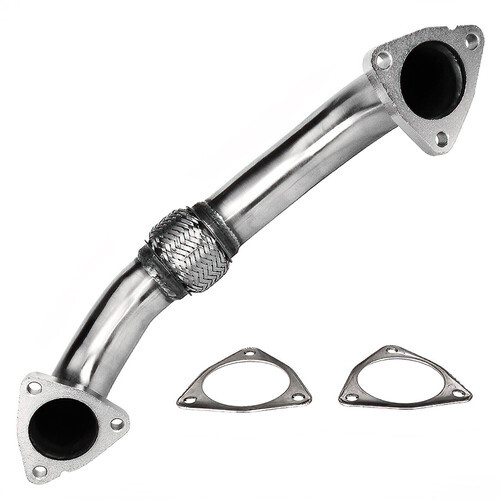
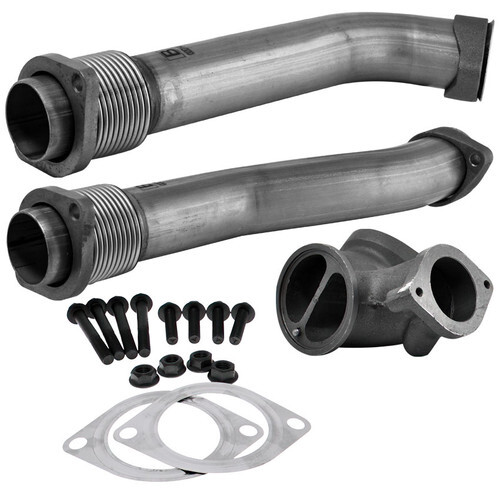
Up Pipes and Exhaust Manifolds
The pipes connecting exhaust manifolds to the turbocharger experience extreme heat cycling. Common issues include:
- Cracked welds allowing exhaust bypass
- Bellows failure on flex sections
- Warped flanges from heat distortion
- Broken or stripped mounting hardware
Exhaust leaks upstream of the turbo reduce available energy and cause elevated exhaust temperatures.
Intercooler and Charge Piping
The intercooler cools compressed air from the turbo before it enters the engine. Inspect for:
- Internal contamination from oil carryover
- External fin damage reducing cooling efficiency
- Cracked tanks or core leaks
- Deteriorated boots and couplings in charge piping
Platform Specific Turbo Issues
Different diesel platforms experience characteristic turbocharger problems worth understanding.
Ford PowerStroke
The 2011 and 2012 6.7L PowerStroke trucks used turbochargers with ceramic ball bearings that proved problematic under heavy loads. Symptoms include a distinctive screaming noise and sudden smoke production when bearings fail. Ford transitioned to steel ball bearings in 2013, improving reliability significantly. Later model years may experience VGT actuator issues and carbon buildup on vanes. Common codes include P2263 and P0299 indicating boost performance problems.
GM Duramax
The LLY Duramax introduced variable vane technology that created new failure points. Vane position sensor failures cause erratic boost and often trigger P2563 or P003A codes. The turbo inlet restriction on LLY models can cause overheating that stresses turbo components. LMM and LML variants commonly develop oil leaks around the compressor housing after extended heat cycling. The L5P uses an electronically actuated Borg Warner turbo that generally shows better reliability than earlier oil pressure controlled units.
Ram Cummins
The 6.7L Cummins uses Holset VGT turbochargers (HE351VE, HE300VG) that commonly experience Stuck Turbo Syndrome from soot accumulation on vanes and actuator failures. Symptoms include loss of power, excessive black smoke, and exhaust brake malfunction. The electronic actuator operates in an extremely harsh environment and represents a common failure point across 2007.5 through current model years. Early attention to boost performance problems prevents complete turbo failure.
Frequently Asked Questions
A failing turbocharger typically produces a high pitched whining or screaming sound that increases with engine RPM. Grinding or scraping noises indicate the compressor or turbine wheel is contacting its housing. Excessive whistling or fluttering may point to boost leaks rather than internal turbo damage.
Driving with a failing turbo is possible but not recommended. You risk oil starvation to engine components if seals have failed, potential engine damage from debris ingestion if wheels break apart, and poor fuel economy from inadequate combustion. Address turbo problems promptly to prevent secondary damage.
With proper maintenance, diesel turbochargers commonly exceed 150,000 miles and may last the life of the engine. Severe duty applications like heavy towing reduce lifespan, while excellent oil maintenance extends it. Variable geometry units require more attention than fixed geometry designs.
Over 90 percent of turbo failures result from oil starvation, oil contamination, or foreign object damage. Proper oil maintenance, quality filtration, and air filter attention prevent most failures. Hot shutdowns and excessive idle time also contribute to premature wear.
Complete turbo replacement typically costs $1,500 to $4,000 for most diesel pickup applications, including parts and labor. Heavy duty commercial trucks may run $3,000 to $6,500 or more. Remanufactured units offer cost savings while new OEM and performance upgrades increase investment.
Rebuild if damage is limited to bearings and seals with wheels and housings in good condition. Replace when wheel damage, housing cracks, or extensive shaft wear exists. Compare rebuild costs to replacement prices and consider time constraints when deciding.
Regular oil changes using correct specifications provide the greatest protection. Maintain clean air filtration, allow cool down periods after hard driving, avoid full throttle on cold engines, and address any boost or smoke issues promptly before they worsen.
Bostech Turbo Solutions
When your diesel truck needs turbocharger service, Bostech Auto offers comprehensive solutions designed to restore performance and reliability. Our turbocharger product line includes remanufactured assemblies for popular platforms, along with the supporting gaskets, seals, and hardware needed for professional installation.
Browse our complete selection of turbocharger components including oil feed lines, drain tubes, gasket kits, and mounting hardware. Each component meets or exceeds OEM specifications to ensure long service life and trouble free operation.
Have questions about your specific application? Contact our technical support team for assistance selecting the right parts for your diesel truck.