
Turbo Up Pipes & Exhaust Leaks: How Pre-Turbo Leaks Kill Performance
Mar 31st 2026
Table of Contents
- What Are Turbo Up Pipes and Why Do They Matter?
- How Pre-Turbo Exhaust Leaks Destroy Performance
- Symptoms of Leaking Up Pipes and Exhaust Connections
- Ford PowerStroke Up Pipe Problems by Generation
- Duramax Up Pipe Problems
- Ram Cummins Exhaust Manifold and Turbo Connection Issues
- Up Pipe Gasket Types: Donut, MLS, and Bellows Designs
- How to Diagnose Pre-Turbo Exhaust Leaks
- Up Pipe Replacement: What to Expect
- Related Components to Address During Up Pipe Service
- Bostech Turbo System Products
- Frequently Asked Questions
What Are Turbo Up Pipes and Why Do They Matter?
In a turbocharged diesel engine, the turbocharger sits between the exhaust manifolds and the rest of the exhaust system. Exhaust gases exit the cylinder heads through the exhaust manifolds, travel through connecting pipes to the turbocharger's turbine inlet, spin the turbine wheel, and then exit through the downpipe to the rest of the exhaust system. The pipes that connect the exhaust manifolds to the turbocharger are commonly called up pipes, because they route exhaust up from the lower manifolds to the turbo positioned above them in the engine valley.
On a V8 diesel engine like the Ford PowerStroke or GM Duramax, there are typically two up pipes (one from each bank) that merge at a Y collector before entering the turbo's turbine housing. On inline six cylinder engines like the Cummins, the turbocharger typically bolts directly to the exhaust manifold, eliminating the need for separate up pipes. However, the Cummins platform has its own set of pre turbo exhaust leak issues related to the exhaust manifold and turbo mounting gaskets.
Up pipes may seem like simple exhaust routing components, but they serve a critical function in the turbocharger system. Every cubic foot of exhaust gas that leaks out of an up pipe before reaching the turbine wheel is energy that never gets converted into boost pressure. Even small pre turbo exhaust leaks can have a measurable impact on turbo spool time, peak boost pressure, exhaust gas temperatures, fuel economy, and overall engine performance. Large leaks can make a truck feel like the turbo is barely functional.
Understanding why up pipes fail, how to recognize the symptoms of pre turbo exhaust leaks, and what replacement options are available helps diesel truck owners address one of the most common and most overlooked causes of performance loss in turbocharged diesel engines.
How Pre-Turbo Exhaust Leaks Destroy Performance
To understand why pre turbo exhaust leaks are so damaging to performance, it helps to understand the basic energy flow in a turbocharger system. The turbocharger is an exhaust driven air pump. The more exhaust energy that reaches the turbine wheel, the faster the turbo spools, the more boost it produces, and the more efficiently the engine runs. When exhaust gas leaks out before reaching the turbine, the entire system loses efficiency.
It is important to distinguish between pre turbo exhaust leaks (before the turbine) and post turbo exhaust leaks (after the turbine). A leak after the turbocharger, such as a cracked downpipe or loose DPF connection, primarily creates noise and may cause exhaust odor issues, but it does not significantly affect turbo performance because the exhaust energy has already been used to spin the turbine. A pre turbo leak, however, diverts exhaust energy away from the turbine wheel before it can do any useful work.
The performance consequences of pre turbo exhaust leaks are significant and compound on each other:
- Reduced turbine drive energy: Less exhaust gas reaching the turbine means the turbo spins slower and produces less boost pressure. Even a moderate up pipe leak can reduce peak boost by 3 to 5 PSI or more, which translates directly to measurable power loss
- Increased turbo lag: With less exhaust energy available, the turbocharger takes longer to spool to its operating speed. The delay between pressing the accelerator and feeling the turbo come alive becomes noticeably longer, which affects acceleration, passing ability, and grade climbing while towing
- Higher exhaust gas temperatures (EGTs): When the turbo produces less boost, less air enters the combustion chambers. The engine management system still delivers fuel based on driver demand, but with less air available to burn that fuel, combustion temperatures rise. Elevated EGTs accelerate wear on turbocharger components, exhaust valves, and DPF catalysts
- Increased smoke output: The reduced air to fuel ratio caused by lower boost results in incomplete combustion, which produces visible black smoke during acceleration and under load
- Worse fuel economy: The combination of lower boost, higher EGTs, and incomplete combustion means the engine extracts less useful work from each unit of fuel. Drivers often compensate by applying more throttle, further worsening fuel consumption
- VGT calibration disruption: On trucks with Variable Geometry Turbochargers, the ECM continuously adjusts vane position based on expected exhaust flow. An exhaust leak upstream of the turbo introduces a variable that the ECM cannot compensate for, potentially causing erratic boost behavior, VGT related DTCs, and confusion in the diagnostic process
- Exhaust fumes in the cab: Pre turbo leaks allow hot exhaust gases to escape into the engine compartment, where they can be drawn into the HVAC system and enter the passenger cabin. This is both a comfort issue and a serious health concern
Because pre turbo exhaust leaks develop gradually, many owners adapt to the slow decline in performance without realizing how much power they have lost. It is not uncommon for a truck with leaking up pipes to show a 5 to 8 PSI reduction in peak boost pressure, which on a stock calibration diesel truck represents a substantial percentage of the turbo's total output.
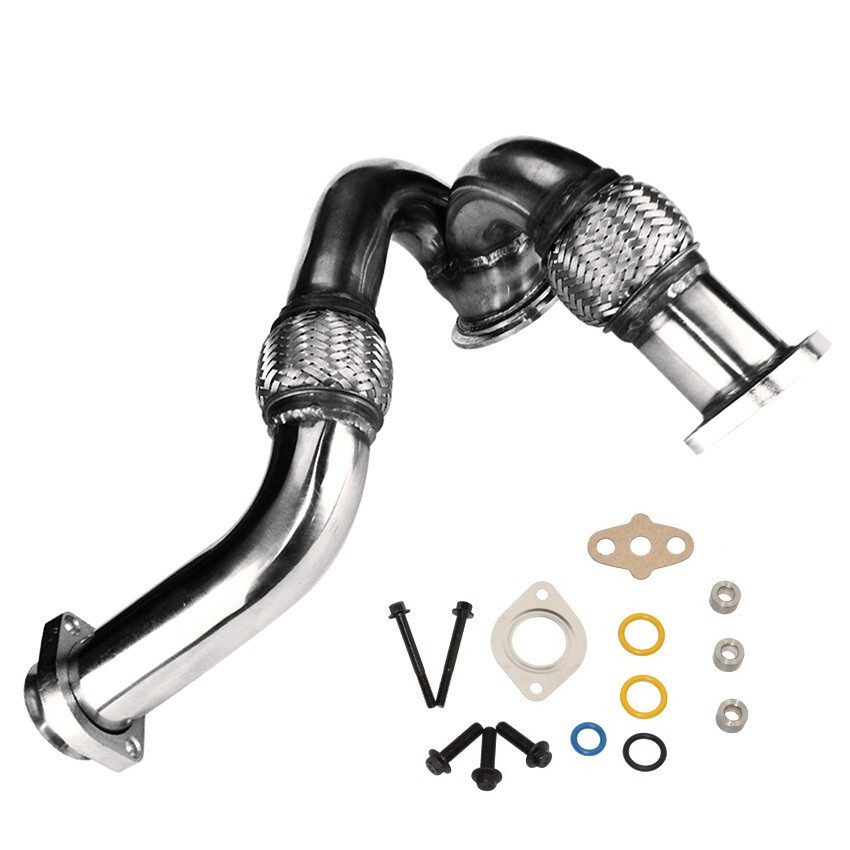
Symptoms of Leaking Up Pipes and Exhaust Connections
Pre turbo exhaust leaks produce a distinctive set of symptoms that, taken together, point strongly toward up pipe or exhaust manifold connection problems. Recognizing these symptoms early prevents unnecessary turbocharger diagnosis and replacement.
Ticking or Hissing Sound
The most recognizable symptom of an up pipe or pre turbo exhaust leak is a rhythmic ticking sound that emanates from the engine compartment, often most audible from behind the firewall or near the turbocharger. This ticking corresponds to the engine's firing order as exhaust pulses escape through the leak. The sound is typically loudest during cold starts (before thermal expansion temporarily closes the gap) and at idle. Under heavy acceleration, the ticking may transition to a hissing or whistling sound as exhaust pressure increases. Some owners describe the sound as similar to an exhaust manifold crack, which makes sense because both are pre turbo exhaust leaks.
In some cases, the ticking actually gets worse as the engine warms up, particularly when the leak is caused by a warped gasket surface or a bellows section that opens further as it expands with heat. Pay attention to changes in the sound character between cold and hot operation, as this helps localize the leak.
Exhaust Smell in the Cab
When exhaust gases escape from up pipes or turbo pedestal connections in the engine compartment, the HVAC system's fresh air intake can pull those fumes directly into the passenger cabin. If you notice diesel exhaust smell inside the truck, particularly at idle or low speeds when the HVAC is on fresh air mode, a pre turbo exhaust leak is a leading suspect. This symptom is more than an inconvenience. Diesel exhaust contains carbon monoxide and particulate matter that pose health risks with sustained exposure. Address any exhaust smell in the cab promptly.
Reduced Boost Pressure and Power Loss
A measurable drop in peak boost pressure is one of the most reliable indicators of a pre turbo exhaust leak. If you have a boost gauge or scan tool capable of displaying boost data, compare your current peak boost readings to the values typical for your platform. A stock Duramax should produce approximately 20 to 33 PSI depending on the generation, while a stock 6.0L or 6.7L PowerStroke typically sees 20 to 28 PSI. A reading consistently 3 to 8 PSI below normal, combined with other up pipe leak symptoms, strongly suggests exhaust energy is escaping before the turbo.
The associated power loss is most noticeable during towing, grade climbing, and aggressive acceleration, the same conditions where the engine demands the most boost. Many owners report that their truck feels significantly more sluggish towing a trailer than it did previously, with the engine needing to downshift more frequently and work harder to maintain speed.
Black Smoke and Elevated EGTs
Because a pre turbo exhaust leak reduces the air available for combustion (by reducing boost), the engine operates with a richer than intended air to fuel ratio under load. This produces black smoke during acceleration and heavy throttle application. If your truck has started smoking more than usual and no changes have been made to tuning or fueling, exhaust leaks deserve investigation.
Elevated exhaust gas temperatures follow the same logic. Less air for combustion means hotter combustion events. Owners who monitor EGTs will notice readings climbing 50 to 150 degrees or more above normal under the same load conditions. Sustained high EGTs accelerate turbo bearing wear, exhaust valve deterioration, and DPF catalyst degradation.
Soot Deposits in the Engine Compartment
Visible soot or carbon deposits on engine components near the turbocharger, firewall, or up pipe connections provide physical evidence of an exhaust leak. Exhaust gas carries fine carbon particles that deposit on surfaces near the leak point, leaving dark stains or buildup that is easy to identify during a visual inspection. Check the area around the turbo pedestal, the Y collector connection, the up pipe to manifold flanges, and the bellows sections (if equipped) for any sign of black carbon deposits.
Ford PowerStroke Up Pipe Problems by Generation
Ford PowerStroke diesel engines have a well documented history of up pipe problems across multiple generations. The V8 configuration and the turbo's position in the engine valley require up pipes to route exhaust from both cylinder banks to the turbocharger, creating multiple potential leak points.
7.3L PowerStroke (1994 to 2003)
The 7.3L PowerStroke uses two up pipes that connect the exhaust manifolds to a Y collector, which then routes exhaust into the turbocharger through the turbo pedestal. The factory up pipes use donut style compression gaskets at the manifold connections. These donut gaskets are the primary failure point on the 7.3L system.
The donut gaskets seal through compression between the up pipe flare and the exhaust manifold outlet. Over thousands of heat cycles, the donut material hardens and the sealing surfaces on the up pipe ends become deformed, developing an hourglass shape that no longer maintains a tight seal. Once the gasket begins to leak, the leak progressively worsens because exhaust erosion further deteriorates the sealing surfaces.
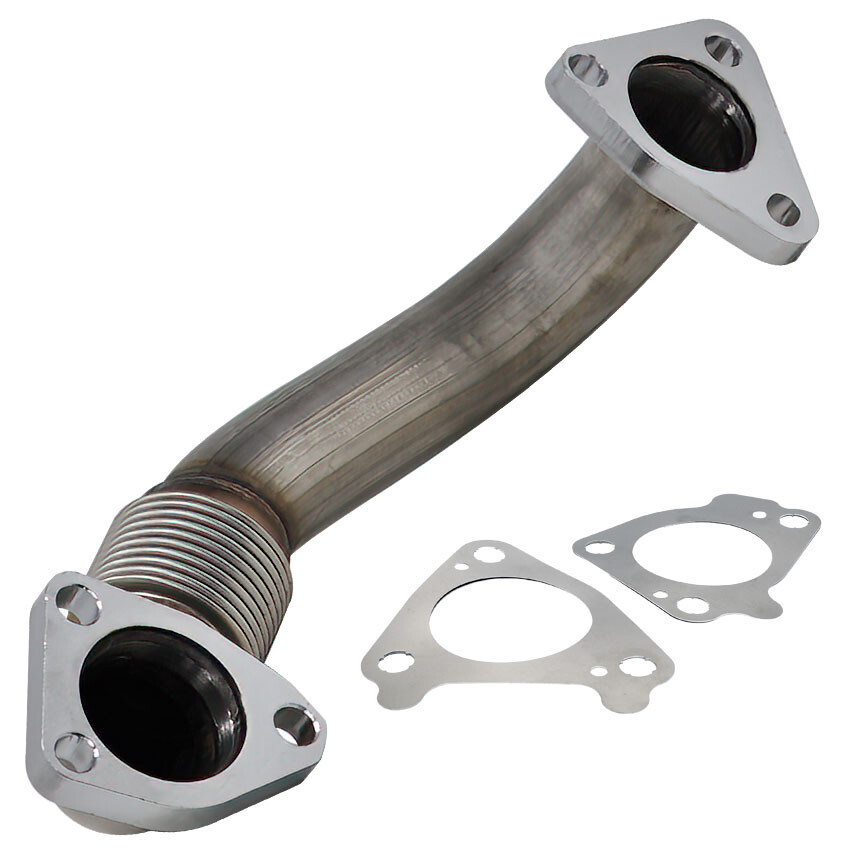
A critical detail about 7.3L up pipe repairs is that simply replacing the donut gaskets often provides only a temporary fix. The factory up pipe ends that the donuts seal against are typically too worn or deformed to hold a new gasket. The industry standard solution is to replace the entire up pipe assembly with an upgraded bellowed design. Bellowed up pipes eliminate the donut gaskets entirely by incorporating a flexible bellows section that accommodates thermal expansion and contraction. This design uses flanges and crush gaskets that provide a more durable and reliable seal. Bostech offers direct fit turbocharger up pipe kits for Ford PowerStroke applications that address this common failure.
6.0L PowerStroke (2003 to 2007)
The 6.0L PowerStroke uses a similar up pipe arrangement to the 7.3L but with the added complication of the EGR riser connecting to the passenger side up pipe. The up pipes on the 6.0L incorporate bellows sections from the factory, which was an improvement over the 7.3L's donut gasket design. However, the bellows themselves have proven to be a common failure point.
The thin wall bellows sections flex with every thermal cycle and eventually develop cracks from metal fatigue. A cracked bellows is difficult to detect visually because the bellows are located behind the engine, below the turbocharger, in a position that is nearly impossible to inspect without disassembly. Many 6.0L owners discover they have a cracked bellows only after significant performance degradation has already occurred.
The right side (passenger side) up pipe is the more common failure point on the 6.0L because it is longer, runs a less direct path to the Y collector, and incorporates the EGR riser connection that introduces additional thermal stress and vibration. The Y collector to turbo pedestal connection is another common leak point. Soot deposits on the firewall behind the turbo and exhaust smell entering the cab are telltale signs of 6.0L up pipe failure.
6.4L PowerStroke (2008 to 2010)
The 6.4L PowerStroke uses a compound turbo system with both a high pressure and low pressure turbocharger. The exhaust routing is more complex than the 7.3L or 6.0L, with up pipes feeding the high pressure turbo first. Up pipe gasket failures on the 6.4L produce the same symptoms as other PowerStroke generations but are compounded by the complexity of the dual turbo arrangement. The connections between the high pressure turbo, low pressure turbo, and the exhaust manifolds all represent potential leak points.
6.7L PowerStroke (2011 to Present)
The 6.7L PowerStroke mounted the turbocharger in the engine valley between the exhaust manifolds, which significantly shortened the exhaust path from the manifolds to the turbo. This design reduced (but did not eliminate) up pipe related issues. The 6.7L uses shorter, more direct exhaust connections with multi layer steel (MLS) gaskets at the manifold to turbo connections. While the shorter path and improved gasket design reduced the frequency of pre turbo exhaust leaks compared to earlier PowerStroke engines, gasket failures still occur, particularly on high mileage trucks or trucks that have had prior turbo service where connections were disturbed.
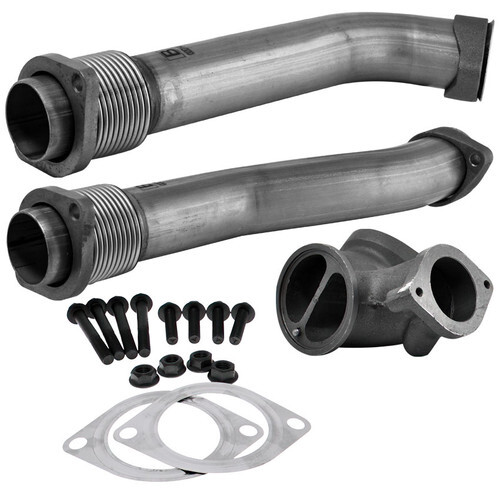
Duramax Up Pipe Problems
The 6.6L Duramax diesel uses a similar V8 up pipe configuration to the PowerStroke, with two up pipes routing exhaust from the cylinder heads to a Y collector that feeds the turbocharger. The Duramax up pipe design has evolved across generations but shares several common failure patterns.
Bellows Section Failures
Duramax up pipes from the LB7 through LML incorporate flexible bellows sections designed to absorb thermal expansion. These bellows are the most common failure point in the Duramax up pipe system. The thin wall corrugated metal fatigues over thousands of heat cycles and eventually develops cracks or, in severe cases, separates completely. A fully separated bellows creates a massive exhaust leak that causes dramatic power loss, heavy smoke, and obvious exhaust sound.
Early stage bellows cracks can be subtle. The crack may only open under pressure when the engine is under load, making it difficult to detect at idle. Some owners report that their truck performs normally during light driving but loses significant power when towing or climbing grades, which is exactly when the higher exhaust pressure forces more gas through the developing crack.
Up Pipe to Turbo Gasket Leaks
The gaskets at the up pipe to turbocharger connection are another common failure point on Duramax trucks. The three bolts securing each up pipe to the turbo operate in extreme heat and are susceptible to stretching, loosening, or breaking over time. Any time the turbo is removed for service and reinstalled, these connections must be torqued carefully to specification to ensure a proper seal. Reusing old gaskets almost always results in a leak.
Multi layer steel (MLS) up pipe gaskets are strongly recommended over single layer alternatives for Duramax applications. MLS gaskets handle the extreme heat cycling better and provide a more reliable seal. A popular choice for Duramax up pipe service is a triple layer MLS gasket set, which offers superior sealing and longevity compared to the stock single layer gaskets.
Cracked Welds and Manifold Connection Leaks
On higher mileage Duramax trucks, the welds on the up pipes themselves can develop cracks from thermal stress and vibration. These cracks are often difficult to see without removing the pipes from the truck because they tend to occur on the underside or at connection points that are hidden from view. Additionally, the up pipe to exhaust manifold gaskets can fail, particularly if the manifold bolts have loosened or if the manifold flange surfaces have warped from heat exposure.
Ram Cummins Exhaust Manifold and Turbo Connection Issues
The Ram Cummins inline six cylinder engine uses a fundamentally different turbo mounting arrangement than the V8 PowerStroke and Duramax engines. The turbocharger bolts directly to the exhaust manifold (or to a short adapter) rather than connecting through separate up pipes. This eliminates the up pipe failure mode entirely, but introduces its own set of pre turbo exhaust leak challenges.
Exhaust Manifold Cracking
Cummins exhaust manifolds are long, single piece castings that span all six cylinders. The length of the manifold makes it vulnerable to cracking from thermal stress. As the manifold heats and cools through thousands of operating cycles, the cast iron develops stress fractures, typically between the center cylinders where thermal stress is greatest. A cracked manifold allows exhaust to escape before reaching the turbo, producing the same ticking sound, power loss, and elevated EGT symptoms as a leaking up pipe on a PowerStroke or Duramax.
The aftermarket addressed this problem with two piece exhaust manifold designs that use a slip fit connection in the center to accommodate thermal expansion. This approach prevents the stress cracking that affects the one piece factory manifold.
Turbo Mounting Gasket Failures
The gasket between the exhaust manifold and the turbocharger mounting flange is a common leak point on Cummins engines, particularly after turbo removal and reinstallation. The mounting studs can stretch or break, and the gasket surfaces can warp from heat. Using new gaskets and properly torqued fasteners during any turbo service is essential. Like the PowerStroke and Duramax platforms, any exhaust leak at this pre turbo connection directly reduces turbocharger efficiency.
Exhaust Manifold Bolt Loosening
The exhaust manifold bolts on Cummins engines are exposed to extreme heat cycling and can loosen or back out over time. Loose manifold bolts allow the manifold gasket to lose its seal, creating an exhaust leak at the cylinder head to manifold interface. This is functionally identical to an up pipe leak in terms of its effect on turbo performance. Checking manifold bolt torque as part of regular maintenance helps prevent this issue.
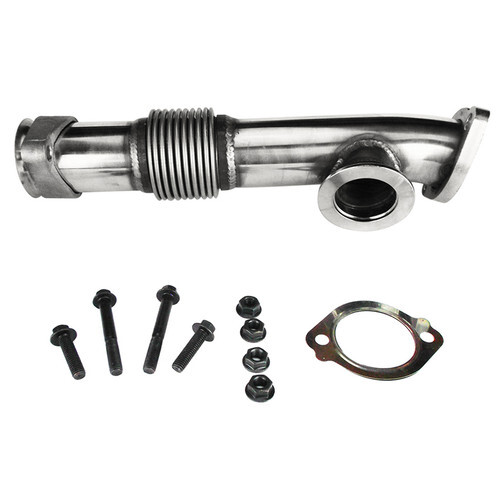
Up Pipe Gasket Types: Donut, MLS, and Bellows Designs
The type of gasket or sealing method used in up pipe connections significantly affects longevity and reliability. Understanding the differences helps you choose the right replacement parts.
Donut (Compression Ring) Gaskets
Donut gaskets are the original sealing method used on 7.3L PowerStroke up pipes and some other applications. The donut is a round, ring shaped gasket that sits between the flared end of the up pipe and the exhaust manifold outlet. The connection relies on compression to maintain the seal. While simple and inexpensive, donut gaskets have a limited service life because the sealing surfaces on the pipes deform over time, and the donut material hardens from repeated heat exposure. Once disturbed during service, donut gaskets rarely reseal properly if the pipe surfaces are worn.
Multi Layer Steel (MLS) Gaskets
MLS gaskets use multiple layers of stainless steel with embossed sealing beads to create a durable, high temperature seal. These gaskets are the standard for turbo to up pipe and manifold to turbo connections on modern diesel trucks. MLS gaskets handle thermal cycling significantly better than single layer gaskets and provide consistent sealing force across a wide temperature range. Triple layer MLS gaskets are recommended for Duramax up pipe service because they offer superior durability compared to stock single layer gaskets.
Bellowed Up Pipe Designs
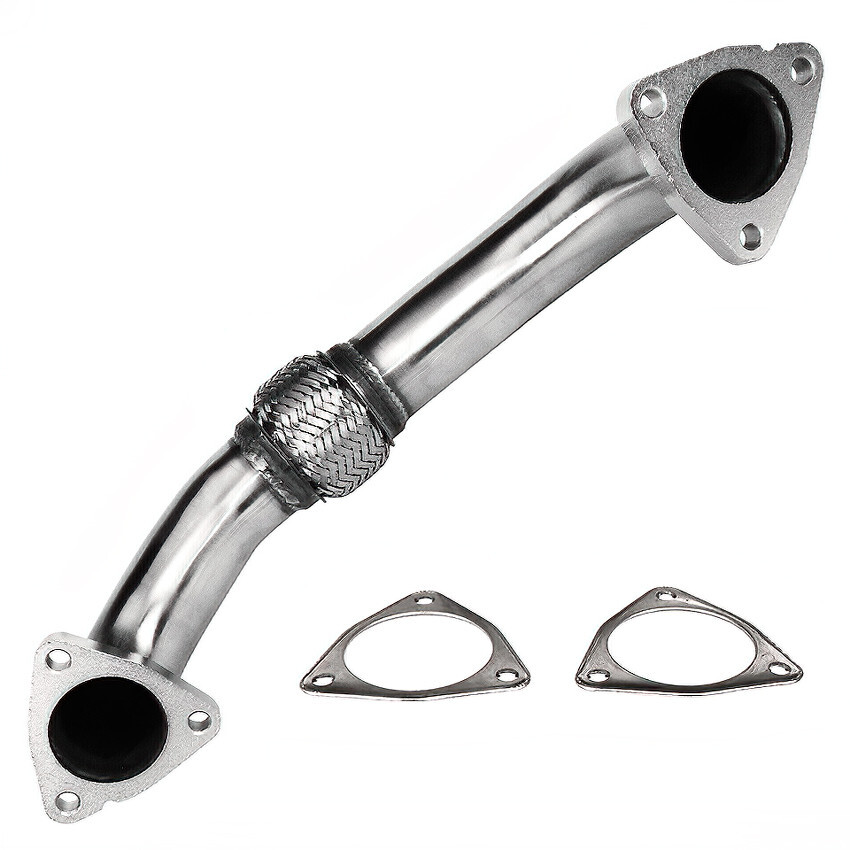
Bellowed up pipes incorporate a corrugated metal flex section that absorbs thermal expansion and contraction without relying on a gasket to compensate. This design approach eliminates the donut gasket failure mode entirely, which is why bellowed up pipes became the industry standard upgrade for 7.3L PowerStroke trucks. The bellows section uses flanges and crush gaskets at the connection points, which provide a more reliable long term seal than compression fit donuts.
The trade off with bellowed designs is that the bellows section itself can eventually fatigue and crack from the constant flexing. However, quality bellowed up pipes with properly engineered wall thickness and material selection significantly outlast the factory donut gasket arrangement. When replacing up pipes on any platform, choosing a design with robust bellows construction and stainless steel materials provides the best long term durability.
How to Diagnose Pre-Turbo Exhaust Leaks
Diagnosing pre turbo exhaust leaks requires a systematic approach because the leak sources are often hidden behind the engine in areas that are difficult to access visually.
Listen for the Telltale Tick
Start the engine cold and listen carefully from various positions around the engine compartment, paying particular attention to the area behind the engine near the turbocharger and firewall. Pre turbo exhaust leaks produce a rhythmic ticking that follows the engine's firing pattern. Compare the sound character between cold and fully warmed up operation. A leak that changes in intensity with temperature suggests a thermal expansion related failure such as a cracked bellows or warped gasket surface.
Visual Inspection for Soot
Inspect the engine compartment for soot deposits, particularly on the firewall behind the turbo, on the hood insulation above the turbo, and on any accessible up pipe or Y collector surfaces. Exhaust leaks leave distinctive black carbon trails that trace back toward the leak source. On Ford 6.0L trucks, check the firewall insulation directly behind the turbo pedestal area. On Duramax trucks, look at the up pipe to turbo connection bolts and the area around the bellows sections from below.
Pressurize the Exhaust System
For a definitive leak test, pressurize the exhaust system with low pressure shop air (5 to 10 PSI is sufficient for pre turbo leak detection). This can be done by fabricating a plug for the tailpipe or downpipe exit and introducing air from a regulated source. With the exhaust pressurized, spray soapy water on all up pipe connections, bellows sections, manifold gaskets, turbo pedestal connections, and Y collector joints. Bubbles indicate the exact leak location. Alternatively, a smoke machine connected to the exhaust system provides excellent visual identification of leak points, even small ones.
Monitor Boost Data
Using a scan tool or aftermarket gauge, record peak boost pressure during a consistent test (the same hill, same gear, same throttle position). Compare your readings to known good values for your specific platform and tune. If peak boost is consistently below normal and a cold side boost leak test has ruled out charge air system leaks, a pre turbo exhaust leak is the most likely remaining cause.
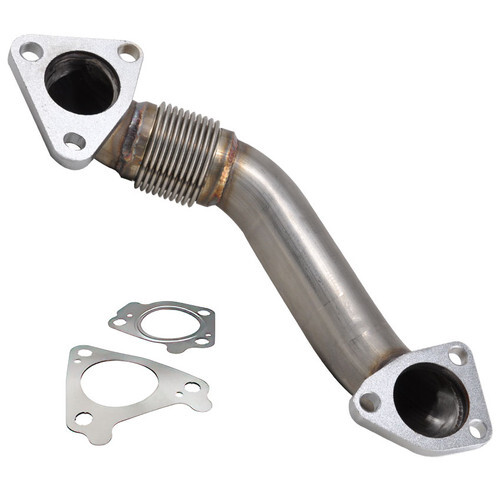
Up Pipe Replacement: What to Expect
Up pipe replacement is a labor intensive job on most diesel platforms, but it does not typically require specialized tools beyond standard hand tools and patience. Here is what to expect for each major platform.
Ford 7.3L and 6.0L PowerStroke
On 7.3L and 6.0L PowerStroke trucks, up pipe replacement is commonly performed with the transmission in place, working from above and below the engine. The turbo typically stays in position, though the turbo pedestal connections must be loosened to separate the Y collector. The biggest challenges are accessing the up pipe to manifold bolts (which are buried behind the engine) and dealing with corroded or seized fasteners. Expect the job to take a full day for a first timer, or 4 to 6 hours for an experienced technician. Soak all fasteners with penetrating oil well in advance of disassembly.
When replacing 7.3L up pipes, always upgrade to bellowed units rather than replicating the factory donut gasket design. Also replace the turbo pedestal O rings while access is available, as these are another common leak point and cost only a few dollars for the parts.
GM Duramax
Duramax up pipe replacement is slightly more accessible than the PowerStroke because the Duramax turbo position allows reasonable access from above. Removing the downpipe first provides more working room. The up pipe to turbo bolts (three per side) and the up pipe to manifold bolts are the primary connection points. Always use new MLS gaskets at all connections and torque to specification. Many technicians recommend torquing the turbo side connections first, then aligning and torquing the manifold side.
If one up pipe has failed, inspect the other carefully before reassembly. Both up pipes are exposed to the same thermal cycling, and if one bellows has cracked, the other is likely not far behind. Replacing both at the same time avoids repeating the labor shortly after the first repair.
Ram Cummins
Since the Cummins turbo bolts directly to the exhaust manifold, addressing pre turbo exhaust leaks typically involves replacing the manifold gasket and/or the turbo mounting gasket rather than up pipes. Cummins turbo removal is relatively straightforward: disconnect the oil feed and drain lines, coolant lines (if applicable), actuator harness, charge air piping, and the exhaust connections. Four bolts secure the turbo to the manifold. If the exhaust manifold itself is cracked, manifold replacement or installation of a two piece aftermarket manifold is the appropriate repair.
Related Components to Address During Up Pipe Service
Since up pipe replacement involves significant disassembly, it is cost effective to inspect and replace related components during the same service. Addressing these items while access is available prevents future repeat repairs.
- Turbo pedestal O rings and gaskets (Ford PowerStroke): The turbo pedestal on 7.3L and 6.0L trucks uses O rings that deteriorate with age and heat. These inexpensive seals should always be replaced during up pipe service
- Exhaust manifold gaskets: If the exhaust manifolds have been removed or loosened to access the up pipes, install new manifold gaskets. Reusing old manifold gaskets after they have been disturbed almost always results in new leaks
- Exhaust manifold bolts and studs: Corroded or stretched manifold bolts should be replaced. Consider upgrading to stainless steel hardware on platforms where corrosion is a recurring issue
- EGR cooler gaskets: On trucks with EGR systems routed through or near the up pipes (particularly the 6.0L PowerStroke), inspect and replace EGR related gaskets while access is available. Bostech offers remanufactured EGR coolers for multiple diesel platforms
- Downpipe gaskets and V band clamps: The turbo to downpipe connection is often disturbed during up pipe service. Replace the downpipe gasket and inspect the V band clamp for proper tension
- Turbo oil feed and drain line gaskets: If the turbo was loosened or moved during up pipe access, replace the oil line gaskets to prevent oil leaks
- VGT solenoid and connector: While the turbo area is accessible, inspect the VGT solenoid connector for corrosion or damage. A Bostech WH02618 wiring pigtail replacement ensures a clean electrical connection and can prevent future actuator related problems
Bostech Turbo System Products
Bostech Auto offers a comprehensive selection of turbo system components designed to support exhaust system repairs and turbocharger maintenance across popular diesel platforms. When addressing up pipe leaks and pre turbo exhaust problems, Bostech products help ensure a complete, reliable repair.
- Turbocharger Up Pipe Kits: Bostech offers direct fit turbocharger up pipe kits for Ford PowerStroke applications. These kits are built to factory specifications for direct fit replacement, requiring no modifications for installation
- VGT Control Solenoids: The Bostech TBC0166268 is a new, direct replacement VGT solenoid for Ford 6.0L PowerStroke and GM 6.6L Duramax applications, available to replace during turbo service. The Bostech TBC0166710 covers 2006 to 2019 Duramax applications
- VGT Solenoid Connector Pigtail: The Bostech WH02618 wiring pigtail for Ford and GM applications addresses corroded connectors that are commonly discovered during turbo area service
- Turbocharger Actuators: Bostech TBC0467800 remanufactured turbocharger actuator for 2013 to 2020 Cummins 6.7L applications
- EGR Coolers: Bostech remanufactured EGR coolers are engineered for improved reliability over original equipment. Available for multiple diesel platforms including PowerStroke and Cummins applications
- Exhaust Gas Temperature (EGT) Sensors: Bostech EGT sensors for PowerStroke and other diesel applications provide accurate exhaust temperature monitoring that helps identify developing exhaust system problems
- Remanufactured Fuel Injectors: Bostech Silver Series remanufactured injectors for LB7 Duramax, PowerStroke, and other platforms help protect turbocharger health by preventing fuel dilution of engine oil
- Complete Turbocharger Assemblies: PurePower Technologies turbocharger assemblies available through Bostech for Ram Cummins, Sprinter, and other diesel applications
All Bostech turbocharger products are backed by generous warranty coverage. VGT solenoids and actuators carry a 24 month unlimited mileage warranty, while PurePower turbo assemblies include a 12 month unlimited mileage warranty. Technical support is available by contacting Bostech Customer Service at 1 800 868 0057 or by email at customerservice@bostechauto.com. Browse the complete selection of Bostech turbo system products at bostechauto.com.
Frequently Asked Questions
A pre turbo exhaust leak occurs between the engine's exhaust ports and the turbocharger's turbine inlet. This includes leaks at exhaust manifold gaskets, up pipe connections, bellows sections, and turbo inlet flanges. Pre turbo leaks directly reduce turbocharger performance by diverting exhaust energy away from the turbine wheel. A post turbo leak occurs after the turbine, in the downpipe, DPF, or tailpipe sections. Post turbo leaks primarily cause noise and exhaust odor but do not significantly affect boost production because the exhaust energy has already been used to drive the turbine.
The power loss from a leaking up pipe depends on the severity of the leak. A small crack or weeping gasket may reduce peak boost by 2 to 3 PSI, which translates to a modest but noticeable power decrease, particularly under load. A fully cracked bellows or blown donut gasket can reduce peak boost by 5 to 10 PSI or more, resulting in dramatic power loss, heavy smoke, severe turbo lag, and dangerously elevated exhaust gas temperatures. In extreme cases with large leaks, the turbo may barely spool at all.
A minor up pipe leak will not prevent the truck from being driven, but it is not advisable to ignore it. Even a small leak reduces performance, increases fuel consumption, elevates exhaust temperatures, and allows toxic exhaust fumes into the engine compartment (and potentially the cabin). More importantly, a small leak will progressively worsen as exhaust erosion enlarges the opening. Towing with a significant up pipe leak is particularly risky because the higher exhaust pressures under load force more gas through the leak and the elevated EGTs can damage the turbocharger, exhaust valves, and aftertreatment components.
The most effective method is to pressurize the exhaust system with low pressure shop air (5 to 10 PSI) through the tailpipe or downpipe and spray soapy water on all pre turbo connections, gaskets, and bellows sections. Bubbles indicate the leak location. A smoke machine connected to the exhaust provides even better visual identification. Without specialized equipment, you can start the engine cold and listen for a ticking sound from the engine compartment near the turbo area, and visually inspect for soot deposits on the firewall, hood insulation, and up pipe connections.
On V8 diesel engines (PowerStroke and Duramax), it is strongly recommended to replace both up pipes simultaneously. Both pipes are exposed to the same thermal cycling and operating conditions, so if one has failed, the other is likely nearing the end of its service life as well. Replacing only the failed pipe often results in the other pipe failing within months, requiring the same labor intensive job to be repeated. The additional cost of the second pipe is minimal compared to the labor savings of doing both at once.
Bellowed up pipes incorporate a corrugated metal flex section (bellows) that absorbs thermal expansion and contraction. This design eliminates the need for donut style compression gaskets that were used on factory 7.3L PowerStroke up pipes. As the engine heats up and the metal expands, the bellows section flexes to accommodate the movement while maintaining a sealed connection at the flanged ends. Bellowed designs are considered superior because they address the root cause of the factory seal failure: the inability of a rigid pipe and compression gasket to accommodate hundreds of degrees of temperature change over thousands of cycles.
Yes. A significant pre turbo exhaust leak reduces the exhaust energy reaching the turbocharger, which lowers boost production. The ECM monitors boost pressure and compares it to expected targets. When actual boost consistently falls below the target, the ECM can trigger P0299 (turbocharger underboost condition) and other turbo related codes. On VGT equipped trucks, the ECM may also set vane position or turbo performance codes because the reduced exhaust flow affects how the VGT system responds to commanded positions. This is why up pipe leaks are sometimes misdiagnosed as turbocharger failures, leading to unnecessary and expensive turbo replacement.
Quality replacement up pipes with bellowed designs typically last 150,000 miles or more when installed correctly. Stainless steel construction offers the best longevity because it resists both corrosion and thermal fatigue better than mild steel. The gaskets at the connection points may need attention before the pipes themselves, so using high quality MLS gaskets and proper torque specifications during installation maximizes the service life of the entire system.
Use a high temperature rated anti seize compound (typically nickel or copper based) on all exhaust fastener threads and on the turbo pedestal studs. Standard anti seize compounds break down at exhaust temperatures and lose their effectiveness. High temperature anti seize prevents fasteners from seizing due to corrosion and heat cycling, which makes future service significantly easier. Do not apply anti seize to gasket sealing surfaces, only to threaded fasteners.
Parts costs for a complete up pipe kit range from approximately $150 to $500 depending on the platform and the quality of the replacement pipes. Premium stainless steel bellowed kits for the 7.3L PowerStroke typically fall in the $250 to $450 range. Duramax up pipe replacements with MLS gasket sets are generally $150 to $350. Professional labor for up pipe replacement ranges from $400 to $1,200 depending on the platform, shop rates, and whether additional components (manifold gaskets, turbo pedestal O rings, downpipe) are addressed simultaneously. The total job typically falls between $600 and $1,500, which is significantly less than the unnecessary turbo replacement that up pipe leaks are sometimes misdiagnosed as.